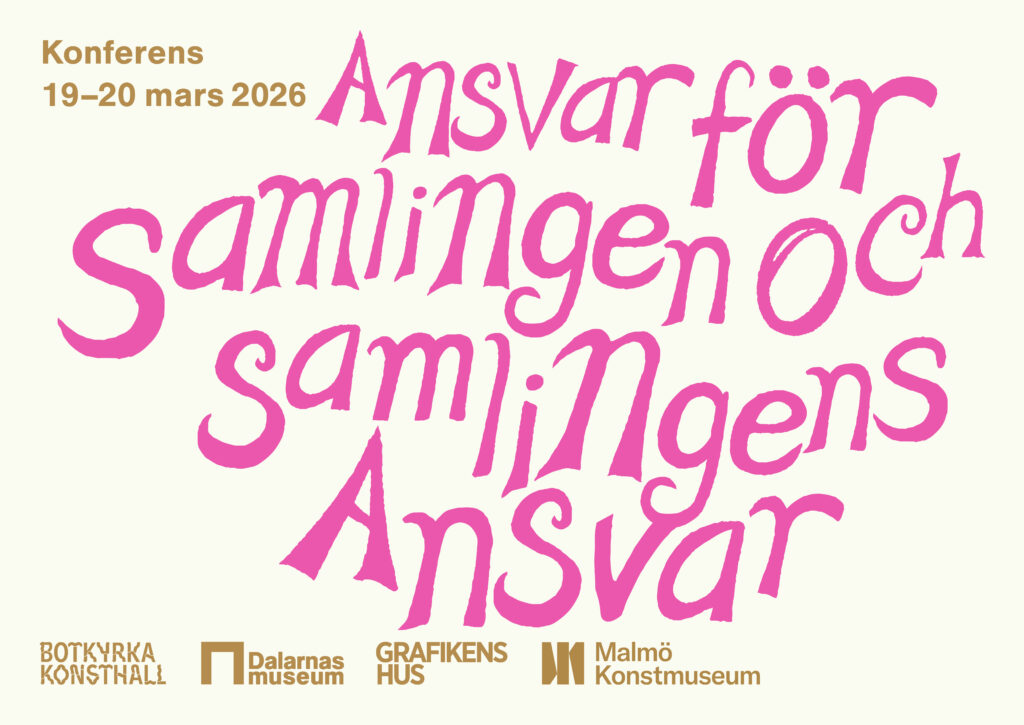
PROGRAM/PROGRAMME: Ansvar för samlingen och samlingens ansvar, 19-20/3
Ladda ner programmet på svenska här – delas även ut på plats!
The conference addresses issues concerning art collections as spaces for critical thinking, artistic inquiry, and rethinking the structures of collections and collecting. How can the colonial systems and exclusionary structures inherent in museum collections be challenged? How can we think of collections as places of responsibility?
Artists, art educators, and representatives from civil society involved in the project present their work and the results of their research in the printmaking collections. Our collaborating partners share insights from the project. Invited guests give presentations based on the project’s theme the responsibility of art museums and their work with collections.
The conference and exhibitions are organized as part of the project Husera omtänkande i samlingar (Housing a critical re-thinking within the collections), an initiative led by Grafikens Hus in collaboration with Malmö Art Museum, Botkyrka Konsthall, and Dalarna Museum.
Language: The program will be conducted in both Swedish and English.
Location: Malmö Art Museum in Kungsparken
Accessibility: The venue is wheelchair accessible. If you require special assistance or accommodations, please contact the organizer
PROGRAM
THURSDAY MARCH 19
Part 1: 1 pm–3 pm
Welcome and presentation
By Kirse Junge-Stevnsborg, director at Malmö Konstmuseum, Nina Beckmann, director at Grafikens Hus together with Master of Ceremonies Samuel Girma. Followed by Macarena Dusant, curator, and Anna Jönsson, producer of Housing a critical re-thinking within the collections initiated by Grafikens Hus, that will summarize the project.
Presentations by the collaborative partners in the project Housing a critical re-thinking within the collections Sara Håkansson, and Maria Perers, Dalarnas Museum, Anna Johansson, Kirse Junge-Stevnsborg, and Linda Holster, Malmö Art Museum, and Miriam Andersson Blecher, Botkyrka konsthall.
Language: Swedish
On Pleasure Garden (Twilight)
Presentation by the artist Conny Karlsson Lundgren
Language: English
Paneltalk: To explore collections through art education
Joanna Johnson, artist and art educator, Maria Stiernborg, Lilian Arevalo, and Julia Halyburton, Representatives from Fittja Syjunta, Aleksandra Jarlas, artist.
Moderated by: Emma Dominguez, producer art education at Grafikens Hus.
Language: Swedish
BRAKE: 3 pm–4 pm
Coffee, tea, and light refreshments will be served.
During the brake you get a preview of the exhibition at second floor opening on Friday 20th:
(Re)Mapping Freedom Through Colonial Lines, created by the artist and art educator Joanna Johnson in collaboration with Abdalla Eltayeb, Vanessa Boateng, Jimmy Touré/ Black Archives Sweden.
Pleasure Garden (Twilight), an installation and performance by the artist Conny Karlsson Lundgren.
Part 2: 4 pm–5.30 pm
Turkos hägring
Presentation by the artist Jasmin Daryani
Language: Swedish
Ultra Mare: A Hauntological Reading of the Archive Beyond the Sea
Presentation by the artist Mehregan Meysami
Language: English
Hosting Is Not Hospitality – On Collections, Power, and the Right to Host
Lecture by the artist/architect Sandi Hilal
Followed by a session between Sandi Hilal and Linda Holster, Malmö Konstmuseum.
Language: English
EVENING PROGRAMME
6 pm Performance Pleasure Garden (Twilight)
Pleasure Garden (Twilight), an installation and performance by the artist Conny Karlsson Lundgren. (Pre-booked tickets only)
FRIDAY MARCH 20
PART 1: 9 am–10.45 am
Welcome!
Macarena Dusant, Grafikens Hus, och Linda Holster, Malmö Konstmuseum together with the Master of Ceremonies, Samuel Girma, welcomes everyone to the second day of the conference.
Museums are Temples of Whiteness
Lecture by Sumaya Kassim
Language: English
Panel talk: Housing a critical re-thinking and conflicts in the collection
Sara Håkansson and Maria Perers, Dalarna Museum, Anna Johansson, and Linda Holster, Malmö Art museum, Miriam Andersson Blecher, Botkyrka konsthall, Macarena Dusant, and Anna Jönsson, Grafikens Hus.
BRAKE: 10.45 am –11.30 am
Coffee, tea, and light refreshments will be served.
Act III: Besin byartist Gülbeden Kulbay is held during the brake.
Part 2: 11.30 am–1 pm
Speculations on Collecting
Lecture by Sepake Angiama, artistic director, the Institute of International Visual Arts (iniva)
Language: English
Conversation between Jonelle Twum, founder and artistic drector, Black Archives Sweden, and Kaitlene Koranteng, archivist and poet, iniva
Language: English
Reflektion and thank you
Closing remarks by Robert Nilsson Mohammadi (Malmö universitet) and students from the Bachelor’s Programme in History: Specializing in Cultural Heritage Studies.
Master of Ceremonies, Samuel Girma, and curator Macarena Dusant, thank the audience for joining.
Language: Swedish
BIOGRAPHIES
Samuel Girma is a writer, essayist, cultural producer and activist. He has worked as curator and communicator at the art space Konsthall C and CinemAfrica Film Festival as well as a producer for the independent media platform Kontext Press. Girma is also co-founder of the anti rasist intersectional and feminist platform Black Queer Sweden and Reclaim Pride.
Conny Karlsson Lundgren – In Pleasure Garden (Twilight), an installation and performance work by artist Conny Karlsson Lundgren, queer narratives from the Malmö Art Museum’s print collection are interwoven with Kungsparken as both a physical and historical site. Through body, desire, and botany, fragments of the collection are echoed in short sequences of voice and movement. In collaboration with the Malmö-based choreographer Khamlane Halsackda, the stories move by association through time, lingering in various traces and glimmers of memory. With the help of film, text, image, installation and performance, Conny Karlsson Lundgren’s work traverses the porous boundaries between social, political, and private identities—reimagined through experience, desire, and secret codes. He is represented in the collections of Moderna Museet in Stockholm, Malmö Art Museum, and the Hasselblad Foundation, among others. Karlsson Lundgren studied at the Jan van Eyck Academie in Maastricht and Valand Academy of Fine Arts in Gothenburg. In 2024, he had a solo exhibition at Bonniers Konsthall, and in 2023, he created Gläntan, Sweden’s first LGBTQI+ monument, commissioned by the city of Gothenburg. He shares his time between Hoby Mosse and Stockholm
Joanna Johnson is a visual artist and printmaker with a background in social work. Moving across printmaking, textiles, and ceramics, she investigates the intersections of memory and heritage, mapping the fluid boundaries between individual identity and collective experience. With an interest in trauma and recovery, Johnson explores holistic perspectives that challenge the separation between mind and body —a binary that has long dictated Western discourse on health and science. Alongside her own art practice, Joanna Johnson works as an illustrator and creative facilitator and has led workshops for a variety of organizations within both the municipal and civil society sectors in Malmö. In that capacity she views the artistic process as a vital catalyst for social change and empowerment, a participatory tool for building agency and fostering deep community engagement.
Maria Stiernborg is a librarian at Fittja Library and one of the initiator of Fittja Syjunta. Within the project Housing a critical re-thinking within the collections, participants of Fittja Syjunta have explored the art collection of Botkyrka konsthall together with art educator and artist Sissela Nordling Blanco
Lilian Arevalo is a representative of Fittja Syjunta. As part of Fittja Syjunta Arevalo has explored the art collection of Botkyrka konsthall together with art educator and artist Sissela Nordling Blanco.
Julia Halyburton is a representative of Fittja Syjunta. As part of Fittja Syjunta Halyburton has explored the art collection of Botkyrka konsthall together with art educator and artist Sissela Nordling Blanco.
Aleksandra Jarlas is a Polish-born artist, curator, and educator based in Sweden whose practice explores how mythological, spiritual, and cultural symbolic systems shape collective imaginaries of identity and power. Working across painting, printmaking, drawing, and installation, she investigates the historical construction of gendered bodies and women’s agency within social and political frameworks. Her work mobilizes mythology as a speculative structure through which dominant narratives can be re-read and reconfigured, positioning the body as a contested site where memory, affect, and ideology intersect. Jarlas studied at the Krzysztof Kieślowski Film School, received a BA from Central Saint Martins in London, and an MFA from Konstfack in Stockholm, where she is currently participating in CuratorLab. Since 2020 she has served as Artistic Director and Curator at Konsthallen Meken. Working between Poland, Czechia, and Sweden, her practice engages Central and Eastern European histories, border imaginaries, and art beyond objecthood—as relation, assembly, and civic gesture.
Mehregan Meysami is an artist who studied architecture and fine art in Tabriz, Pasadena, Oslo, and at the Royal Institute of Art in Stockholm (MFA, 2022). She works media-archaeologically with analog film and text, and her practice includes film, installation, sound, sculpture, and works on paper. Her work is oriented through a political and historical perspective and reflects on questions of representation, authenticity, presence, memory, and time, as well as their erasure. Influenced by historical turning points, her work often involves reinterpretations of history through the recontextualization of text and archival materials. Through an autobiographical perspective, her work addresses colonial histories and questions of nationalism, xenophobia, and statehood. Mehregan Meysami has exhibited in Sweden, Germany, Norway, the United States, and Iran, and her work is included in collections held by several Swedish regions and municipalities.
Jasmin Daryani works across multiple media, weaving together narratives that emerge from the meeting of different conditions, languages, and contexts. Her practice carries a poetics of mixture and encounter — a way of both writing and surviving within the tensions between worlds. Her work explores how power, migration, and belonging are shaped and reshaped, and how history continually inhabits the present. Through repetition and reconstruction, she engages with experiences — both personal and collective — that touch on rootlessness, renewal, and recovery. Her works draw on testimonies from everyday life, from her own journey, and from people close to her. Daryani studied at the School of Photography (now HDK–Valand – Academy of Art and Design) and at Konstfack University of Arts, Crafts and Design. She grew up between Dalarna, Hälsingland, and Gästrikland in Sweden.
Sandi Hilal’s work emerges where architecture, art, and collective life meet. As an architect, artist, and educator, she traces paths through displacement, statelessness, and migration—inviting political imagination to grow through acts of learning together, hosting one another, and reclaiming space as a collective journey of self-determination and the becoming of a more just and inhabitable world. She lives and works through DAAR – Decolonizing Architecture Art Research, an architectural and artistic collective she co-practices with Alessandro Petti. Daar, meaning “home” in Arabic, is both the conceptual ground and shared life of their political, spatial, and pedagogical explorations.
Sumaya Kassim is a writer and editor. Her work centres on museums, repatriation, cultural memory and the (im)possibility of decolonising. Her work includes ‘Museums are Temples of Whiteness’ (Routledge’s Companion to Decolonizing Art History, forthcoming) and the widely read ‘The museum will not be decolonised’ (Media Diversified, 2017). She has written for Art History, the Sandberg Institute and various other platforms. She is also a fiction writer. Her fiction has been published in Lucent Dreaming, The Good Journal, The Happy Hypocrite, and elsewhere. She was longlisted for the Lucy Cavendish Fiction Prize for Women. She is also prose editor of Middleground Magazine, a literary magazine for creatives of mixed heritage.
Gülbeden Kulbay is an interdisciplinary artist based in Stockholm, Sweden. With a prolific career spanning over 20 years, her varied artistic practice includes performance, community-engaged art, and culinary actions. At the core of her work lie questions and explorations of the body; of presence and sensual experience; of connecting with other bodies, be they human or non-human. Connection, collaboration and negotiation in particular are fundamental to her practice, as she endeavours to illuminate the network of interrelations and interdependencies we are all enmeshed in – to show how we all need each other. In this sense, her works offer a critique of the capitalist mode of living and the sense of alienation from self and others it engenders. Kulbay’s work has been shown in Sweden, across Europe, and the USA, with pieces currently in the collections of Stockholm City, Falun Municipality, Botkyrka Municipality and Grafikens Hus.
Sepake Angiama praxis stems from radical pedagogies, black feminist thought, rethinking human/non–human relations rooted in how we might reimagine and inhabit the world otherwise. She is the artistic director of the Institute of International Visual Arts (iniva), dedicated to developing artistic research, embodied practices, collective study, publishing and community led commissioning that reflects on the social and political impact of globalisation. She has previously held positions at Tate Modern, Manifesta and documenta. Her current research and thinking stems from an interest in spatial justice, speculative thinking and intentional communities grounded in radical imagination towards creating ecologies of care, empathy and kindness.
Jonelle Twum is the founder and artistic director of Black Archives Sweden. Jonelle is also an artist and filmmaker whose practice spans film, installations, text, and theory. Her work addresses themes such as migration, memory, materiality, collectivity, desire, and the body, often explored through Black feminist thought and the rhythms of everyday life.
Kaitlene Koranteng is an archivist and poet with an interest in exploring hidden and marginalised histories and expanding access to archives. Since 2022, she has worked with Iniva (Institute of International Visual Arts), where she supports community-led archival and engagement projects exploring diaspora, identity, and collective memory. Since 2025, she has also served as a Trustee of the Rita Keegan Foundation. An alum of the Young Historians Project and editorial board member of History Matters Journal, she has contributed to initiatives documenting African and Caribbean histories in Britain. Her practice investigates how archives can challenge historical silences and centre lived experience through collaboration and care.
Evelina Mohei is the graphic designer for the project Housing a critical re-thinking within the collections. In her work she collaborates with non-profits and community spaces, and is interested in design as a vessel for narratives—specifically those often overlooked or at risk of being forgotten
Macarena Dusant is an independent art historian, editor and writer. Her work focuses mainly on power structures, the notion of the public realm and mechanisms of exclusion within western contemporary art. She has published books and texts about migrated artists, the diaspora experience and conditions as part of the racialization processes in the Swedish art field as well as texts on public art and the public sphere. Dusant has been involved in different independent cultural and artistic organizations, working mainly with art collectives. As part of the editorial group Kultwatch.se, an online platform for the arts and intersectional cultural analysis founded in 2014, Dusant has been an important public voice challenging whiteness and hierarchies in the Swedish art field. Her writing practice explores a process where she experiments with the hybridization of academic writing, essay, lyric, collective being and dreams, mirroring her diasporic background as part of the global majority. She was the Curator and Process Leader for the project Samlande tankar/Collecting Thoughts, a three year art project where Grafikens Hus – a museum for contemporary printmaking, together with scholars, curators and artists investigates and formulate a vision and methods to build a collection from a post-colonial and intersectional perspective.
Anna Jönsson is deputy director with a focus on learning at Grafikens Hus, and producer of the project Housing a critical re-thinking within the collections. Studies in the Aesthetics Programme at Södertörn University, woke an unwavering drive to explore the intersections of art, culture, social development, and civil society, alongside a commitment to making artistic spaces more accessible.
Emma Dominguez is an artist and art educator with extensive experience in participatory and collective artistic processes. She works part time as an art educator at Grafikens Hus. Within Housing a critical re-thinking within the collections she has mentored art educators in the project.
Nina Beckmann has been the Museum Director of Grafikens Hus since 2012, leading the development of a mobile and collaborative institution for contemporary printmaking. She has strengthened the institution’s national profile and fostered artistic production, experimental programs, and partnerships, guided by the house’s values of openness, diversity, and artistic movement.
Anna Henriksson is a writer and an artist, and has worked as communication manager at Grafikens Hus since 2018. She produces the Grafikens Hus Podcast and was the editor of “Without Walls – Grafikens Hus Mobile Years 2014–2021.” She freelances as a journalist for Fotografisk Tidskrift. This autumn, she is releasing her own photo book, “Agnes samling,” published by Breadfield Press. She was educated at the Department of Journalism, Media and Communication, the Royal Institute of Art in Stockholm, and the Umeå Academy of Fine Arts.
Kirse Junge-Stevnsborg (b. 1974) holds a master’s in Aesthetics and Culture/Art history. She is director of Malmö Art Museum. She has been working for the international NGO art agency ART2030. From 2009 – 2018 she was director of Den Frie Centre of Centemporary Art in Copenhagen. From 2006 – 2009 she worked as director at Gävle Konstcentrum in Sweden. Previously, Kirse Junge-Stenvsborg worked at Dunkers Kulturhus in Helsingborg, Sweden, The Center for Danish Visual Arts, Copenhagen, Gallery Nicolai Wallner, Copenhagen and Tate Gallery in London. Kirse Junge Stevnsborg serves as board member of several art institutional boards e.g. CHART Art Fair, ADBC, SMK, and has been chairman of the Danish Kunsthalle Association for several years and a member of the Faculty of Fine and Performaning Arts University of Lund
The conference “Responsibility in the Collection and the Collection’s Responsibility”, 19-20 March is organized by Grafikens Hus in collaboration with Malmö Art Museum, Botkyrka Konsthall, and Dalarnas Museum. The project is supported by the Swedish Postcode Lottery Foundation.
Process Leader and Curator: Macarena Dusant, Grafikens Hus
Producer: Anna Jönsson, Deputy Museum Director, Grafikens Hus